Last updated: 22 August 2026
Most guides on this topic open by telling you esports betting is growing fast. That has never helped anyone place a bet.
So we did something else. In August 2026 we opened accounts at two operators, recorded the real prices on live matches, and read every line of the bonus terms.
Everything below comes from that. Real odds. Real numbers. Dates on all of it.
By the end you will know how a bet works, what the odds actually mean, how to pick your first game, and how to spot a bonus that suits the way you bet. It takes about ten minutes.
Where you can bet, and who looks after you
Good news first: esports betting runs on the same licence that covers football. There is no special esports licence to worry about.
That surprises people. They search “is esports betting legal” expecting a separate rule for video games. There isn’t one.
Ontario’s regulator puts it about as plainly as it can be put. On its own player information page, the AGCO says that in Ontario “players can bet on eSports, a form of competition using video games, if the event meets the AGCO’s standard for acceptable events.” Same registration, same standards, same rulebook as any other sport.
So the real question is simpler. Is online sports betting licensed where you live, and is this operator licensed to take you?
Here are the four markets we cover and who regulates each:
- Germany. The Gemeinsame Glücksspielbehörde der Länder, or GGL. Set up under the State Treaty on Gambling that came into force on 1 July 2021. One catch: that treaty does not list esports as a permitted bet, so no GGL-licensed book offers it. Is esports betting legal in Germany? explains what that means for you.
- Netherlands. The Kansspelautoriteit, usually shortened to KSA.
- Canada. Handled province by province rather than nationally. In Ontario, operators must be registered with the AGCO, and the market is run by iGaming Ontario or the Ontario Lottery and Gaming Corporation.
- Philippines. PAGCOR, which is both a government-owned corporation and the country’s principal gaming regulator. Its rules cover wagering on local and international sport, esports and racing.
If you are in one of those four, you are well covered. Licensed operators there answer to a real regulator, and that matters if you ever need to raise a problem.
Betting from one of those markets? We keep a country guide for each, with the books that actually accept players there: esports betting sites in Germany, the Netherlands, Canada and the Philippines.
One note on the United States. The rules change state by state and move faster than any guide can honestly keep up with, so we do not recommend operators there. Everything else on this page still applies.
Your first bet, start to finish
A bet takes about two minutes to place. Getting your account ready takes a little longer, and that is where most people trip up. Here is how to get it right first time.
Step one: understand the price
On 21 August 2026, Betway priced Fnatic against Shifters in the LEC at 2/9 and 14/5. In decimal that is 1.22 and 3.80.
Fnatic were strong favourites. A 10 euro bet on Fnatic returns 12.20 in total, so you profit 2.20. The same 10 euro on Shifters returns 38.00, a profit of 28.00.
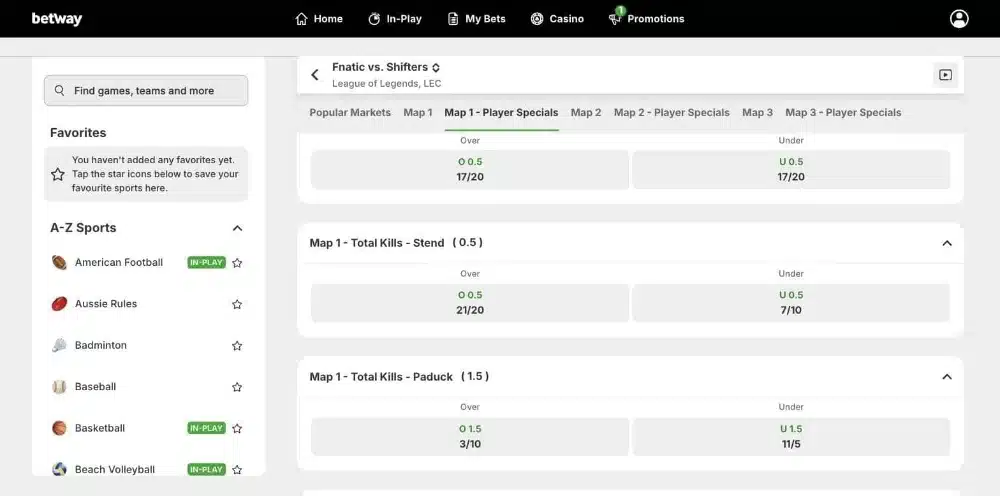
That is the whole idea. Short price, more likely to win, smaller reward. Long price, less likely, bigger reward.
Step two: open the account
Name, date of birth, address, email. Two minutes on a phone.
Step three: get verified, and this is the bit worth planning
Every licensed operator has to check who you are before you can deposit. It is a legal requirement and it protects you as much as them. The banks do exactly the same thing.
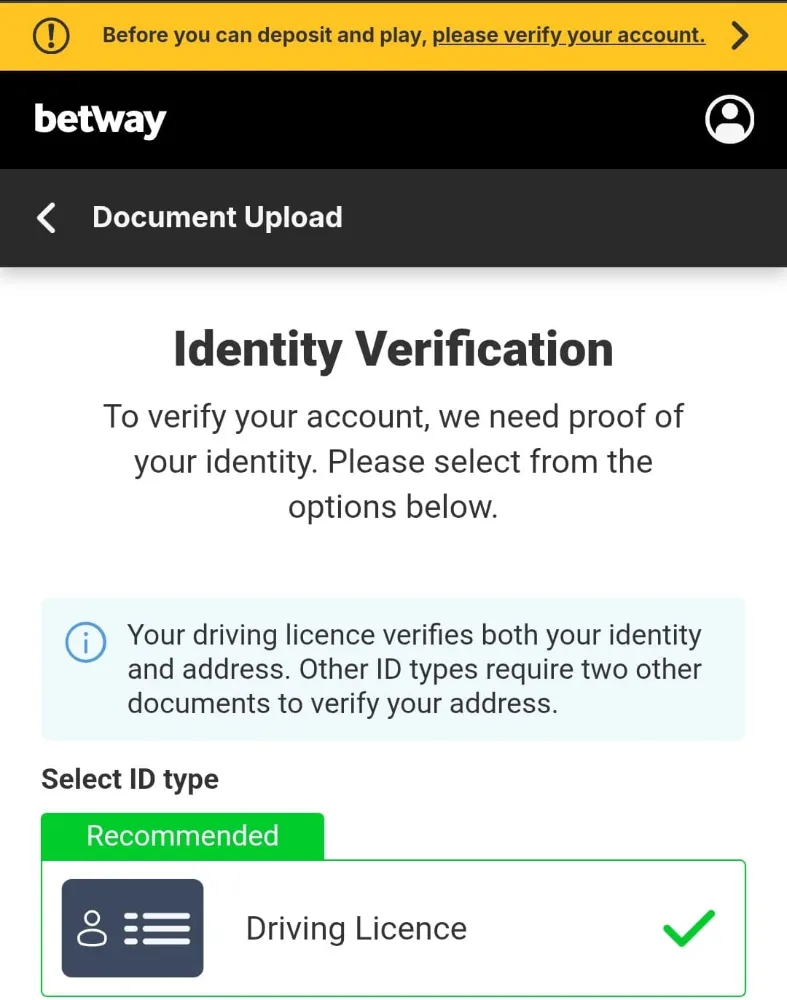
We went through this with Betway on 21 August. Their upload screen explains the rule clearly:
“Your driving licence verifies both your identity and address. Other ID types require two other documents to verify your address.”
That single line tells you everything you need to know.
A driving licence usually clears both checks at once. Any other ID and you will need two more documents showing your address.
Here is where people most often come unstuck. If the address on your photo ID is an old one, the check will not pass, and sending other documents does not always solve it. Worth sorting before you start rather than in the middle.
So before you start, have this ready:
- A photo ID showing your current address, ideally a driving licence
- If that is not possible, two recent documents in your name at your current address, such as a bank statement or a utility bill
- Both as clear photos, all four corners visible
Sort that out first and verification is a five-minute job. Leave it to chance and you can lose an evening.
Reading the odds, with the sums done for you
There are two ways of writing odds, and they mean the same thing. Decimal is the easier one, because the number shown is simply what one unit pays back in total.
Decimal takes one line to learn. Odds of 3.80 means a 1 euro bet returns 3.80. Multiply the odds by your stake and you have your return. That is it.
Fractional takes a sentence more. 14/5 means you win 14 for every 5 you stake, and you get your stake back too. To turn it into decimal, divide the first number by the second and add one. 14 divided by 5 is 2.8. Add 1 and you have 3.80.
Most sites let you switch between the two in settings. Pick whichever you find easier and stop thinking about it.
The bit almost nobody explains
Add both prices together and you can see the bookmaker’s cut.
Divide 100 by each decimal price to get a percentage. Add them up. Anything above 100 is the cut, known as the overround.
Try it on that Fnatic match. 1.22 gives 82.0 per cent. 3.80 gives 26.3 per cent. Together that is 108.3 per cent. The 8.3 above 100 is the bookmaker’s slice.
Lower is better for you. And here is something genuinely useful that we worked out by counting.
We measured both operators across a range of markets in August 2026:
| Market type | GG.BET, 18 Aug 2026 | Betway, 21 Aug 2026 |
|---|---|---|
| Match winners and handicaps | 6.45% | 7.46% |
| Player props such as kills | 8.87% | 8.09% |
Overround measured across live markets. Lower is better for the bettor.
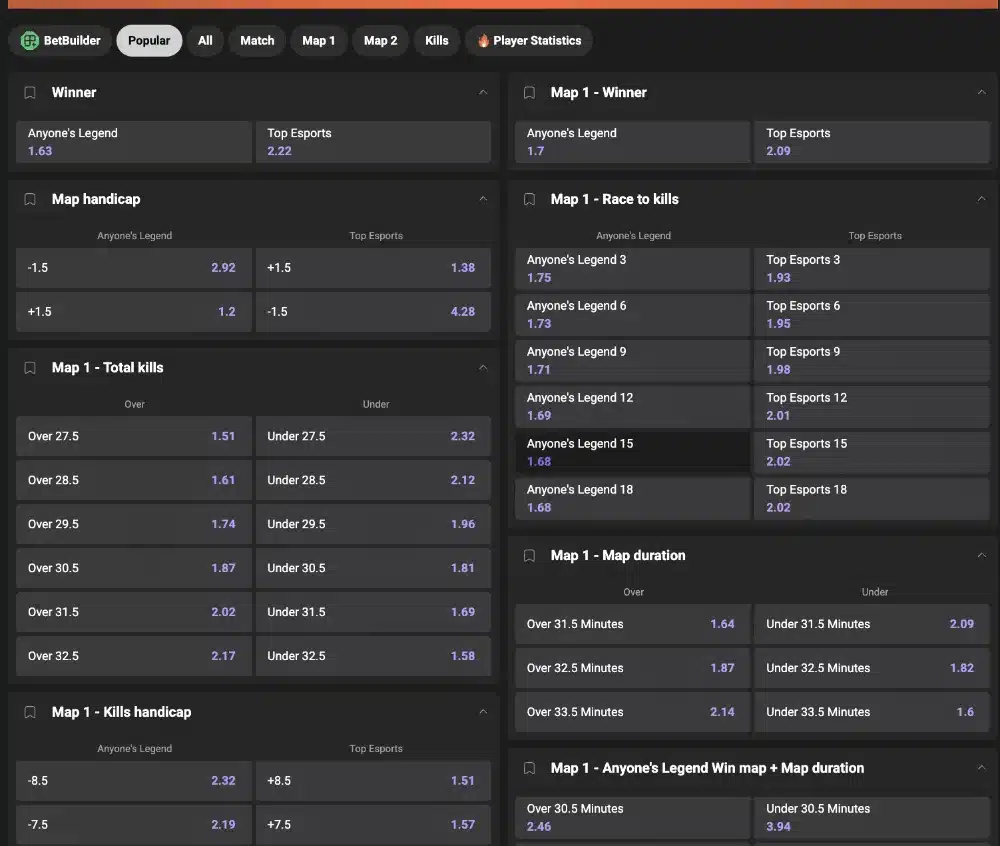
Each one is better at something different, and that is genuinely useful to know.
GG.BET, the esports specialist, gives you a better price on match winners. If you mostly back a team to win, that is where your money goes further.
Betway is the sharper option on player props, the markets on individual kills and match length. It also prices its markets more consistently across the board.
So if you open two accounts over time, you have a simple rule: match winners at the specialist, player props at the mainstream book. Very few people know that, because working it out means sitting down and doing the maths.
Fair caveats. This is a snapshot, taken on two days, on different fixtures. The method is in the paragraph above, so you can run it yourself on any market you like. That is rather the point.
If you would rather not do the arithmetic each time, our no-vig calculator strips the margin out of a price for you.
Picking your first game
Bet on the game you already watch. If you do not watch any of them yet, start with Counter-Strike 2.
The reason is not that CS2 is the biggest. It is that CS2 has the best free statistics of any esport.
HLTV holds head-to-head records, map-by-map win rates and player ratings going back years, and it costs nothing. If you have ever bet on football, the shape of it will feel familiar straight away.
League of Legends has the deepest markets by a distance. On one ordinary league match in August 2026 we counted 32 different market types and more than 700 individual prices, including things that only exist in this game: first dragon type, first baron, how long the map lasts.
That depth is wonderful if you know the game. It is a lot to take in if you do not.
Dota 2, Valorant, Rocket League and the big mobile titles all have proper markets too. Whether they suit you depends on one thing only: can you watch a match and follow what is happening?
That is the honest test. If you can explain why a team is losing while you watch them lose, you have something to work with. If you cannot, you are guessing, and guessing is fine as entertainment but it is not an edge.
How to research a match properly
Three free sources will tell you more than any tipster: the roster, the head-to-head stats, and the team’s own social accounts on the day.
This is the only part of betting you can genuinely get better at, which makes it odd that so few guides cover it.
Start with the roster. Liquipedia is a free community-run wiki covering line-ups, results and tournament brackets for every major esport. Check who is actually playing.
Esports teams use stand-ins far more often than football clubs use trialists. A team with a substitute is a different team, and the odds do not always catch up straight away.
Then the stats. For Counter-Strike 2 that is HLTV. For Dota 2 and CS2, bo3.gg covers similar ground. League fixtures are well served by the league’s own published stats.
Look for something narrower than “who is better”. In CS2, most matches are decided by which maps get banned, so you want recent form on those specific maps rather than overall.
Then the quick one. Check the team’s own social accounts on match day. Roster changes, travel problems and last-minute stand-ins are announced there first.
One last thing, about timing. Markets do not stay open all day. Roughly forty minutes before one match in August 2026 we counted 336 individual player markets. Closer to kick-off, the first map’s player markets closed as expected and the count dropped to 111.
If you want the deep markets, be there early.
Research narrows the guess. It does not remove it. Anyone who tells you otherwise is selling something.
How to check an operator properly
Every licensed operator publishes its licence number in the footer, and every regulator publishes a register you can check it against. It takes two minutes.
One. Scroll to the bottom of the site. The licence number is there, usually in small print near the copyright line, with the name of the company holding it. That company name is often different from the brand name, which is normal.
Two. Note which regulator issued it. In the markets we cover that means the GGL in Germany, the KSA in the Netherlands, the AGCO or another provincial body in Canada, or PAGCOR in the Philippines.
Three. Go to that regulator’s own site and search the register. Not a comparison site. Not us. Theirs.
Four. Think about what that licence gives you. A licence from the regulator in your own market usually comes with somewhere to escalate a complaint, independent of the operator. A licence from further afield may not.
One extra check that takes five seconds
Look for the safer gambling tools before you sign up.
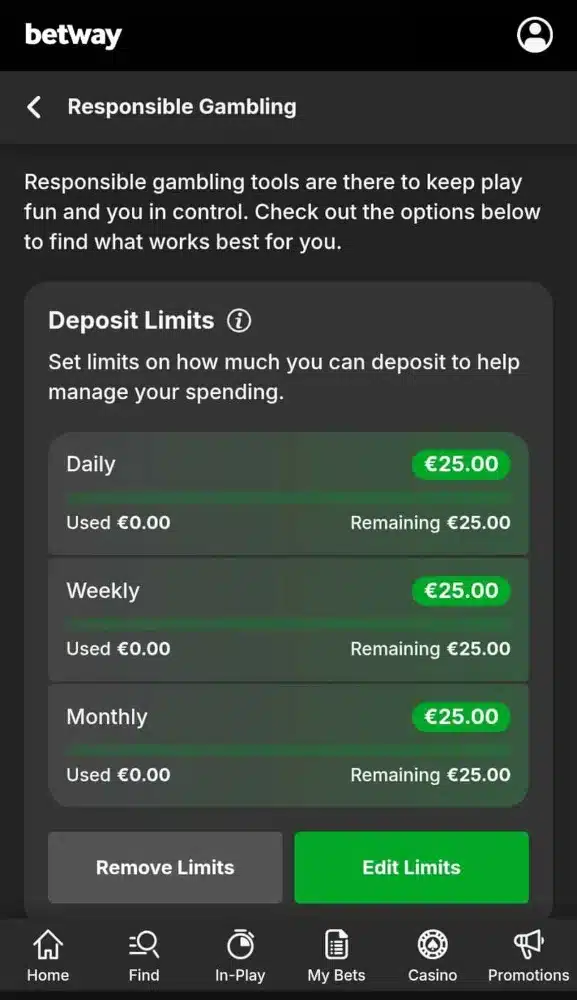
The best operators make this easy, and Betway is a good example of how it should work. When we registered on 21 August 2026, the signup form itself offered daily, weekly and monthly deposit limits, before the account existed and before a single euro went in.
We set all three to 25 euro. The account page then showed each limit with the amount used and the amount remaining, with a progress bar. Session reminders and account exclusion are offered in the same place.
That is what good looks like. Before you open any account, have a quick look for those tools. An operator that puts them in front of you at signup is telling you something about how it treats customers.
If you want to compare what different operators offer, our esports betting sites comparison sets them side by side.
How to get real value from a welcome bonus
A welcome bonus is worth having, as long as you understand what you are agreeing to. The percentage on the banner is the headline. The terms underneath decide whether it suits you.
Here is a real one, read line by line on 18 August 2026.
| Deposit from | Bonus | Freebet | Max bonus |
|---|---|---|---|
| 10 EUR | 100% | 5 EUR | 20 EUR |
| 20 EUR | 120% | 10 EUR | 60 EUR |
| 50 EUR | 130% | 25 EUR | 130 EUR |
| 100 EUR | 150% | 50 EUR | 800 EUR |
GG.BET sports welcome bonus tiers as published on 18 August 2026. Offers change, so check the current terms before you claim.
Wagering is 15 times the bonus, and that is a genuinely good number. Plenty of offers in this industry sit at 30 or 40 times. Fifteen is friendly by comparison, and worth saying so.
Now the part that decides whether it fits you.
The wagering must be cleared on single bets, at odds of 1.75 or longer.
That is not a catch, it is a shape. It simply means the bonus rewards a particular style of betting.
It suits you if you back single selections at middling prices, the kind of match where two teams are fairly close.
It suits you less if you mostly build accumulators, or you like backing strong favourites. That Fnatic price of 1.22 from earlier would sit below the 1.75 line.
Here is the maths, so you can see it clearly. Deposit 20 euro and you receive 24 euro in bonus. You then need to place 15 times that in bets, so 360 euro of turnover, in singles priced 1.75 or above.
At 5 euro a bet, that is around seventy-two bets. Perfectly doable over a season if that is how you bet anyway. A slog if it isn’t.
One more line worth finding in any offer. Check the maximum you can convert from bonus balance into real money. In this one it is twice the bonus on the smaller tiers, and equal to the bonus on the larger ones. Knowing the ceiling in advance saves disappointment later.
The rule to take away: the percentage gets your attention, but the wagering multiple, the minimum odds and the bet type tell you whether the offer actually fits you. Two minutes reading the terms is the best-paid two minutes in betting.
Staking, and knowing when to stop
Set your deposit limit before your first deposit, not after a bad week. On Betway, we found you can do it on the registration form itself, as you sign up.
That is the single most useful thing in this section, so it goes first.
Decide your stake before you start. One to two per cent of the money you have set aside, per bet, and keep it the same. There is nothing clever about it. It works because a fixed stake takes away the decision you are worst at making, which is how much to bet when you are already behind.
Know about chasing. The urge to win it back after a loss is completely normal. It is also the most reliable way that someone who could happily lose 50 euro ends up losing 400. If you notice your stake creeping up after a loss, that is the moment to stop for the night.
Four things that cost nothing:
- Set a deposit limit when you sign up, at a number you would genuinely be fine losing
- Keep your stake the same, win or lose
- Bet on games you enjoy watching anyway, so the evening is good either way
- Never bet money that already has a job. Rent has a job.
And the honest bit. Betting is entertainment you pay for. Sometimes it is free because you win. Over enough bets, the bookmaker’s cut we showed you earlier does its work.
That is not a reason to avoid it. It is a reason to decide the price of the entertainment in advance, the same way you would with a night out.
If it stops being enjoyable, stop. If stopping feels hard, that is worth taking seriously rather than arguing with.
Our responsible gambling page lists the organisations that can help.
Common questions
Is esports betting fair?
Top-tier events in the major titles have integrity monitoring in place, and the licensed operators work with it. Match-fixing has happened in esports, as in every sport, and it clusters in small tournaments with unknown teams and tiny prize money. Stick to the big leagues and you are on solid ground.
How much do I need to start?
Less than you would think. Most operators we looked at in August 2026 accept deposits from 5 to 10 euro. The more useful number is the one you would be comfortable losing, which is not always the same thing.
Can I bet from my phone?
Yes, and most people do. One tip: the mobile list view often shows just two prices and a “more bets” link, which makes a match look thinner than it is. Tap through, or check on desktop, and the full market list is usually there.
What happens if a match is cancelled or a player is substituted?
This sits in the operator’s rules and it is worth a read once. Generally, an abandoned match means stakes are returned. A substitution partway through usually does not void anything, which is the one that catches people out.
How long does a withdrawal take?
It depends on three things: the method you use, whether your account is fully verified, and the operator’s own processing window. E-wallets are usually the quickest, cards sit in the middle, and bank transfers take longest. The single biggest factor is verification. Get your ID approved when you open the account, rather than at the moment you want your money, and the whole thing moves faster.